Resources
by Jon Yablonski
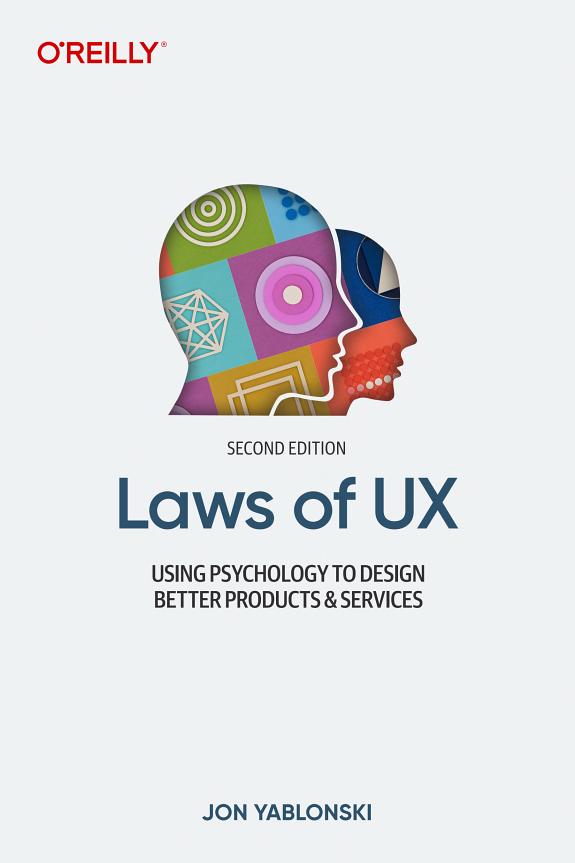
Laws of UX explores the fundamental principles that guide user experience design through a set of laws or rules drawn from psychology and human behavior.
Key Concepts
Fitts's Law
Time to reach a target is proportional to distance and inversely proportional to size — make buttons large and accessible.
Hick's Law
Decision time increases with the number of options — reduce or categorize choices.
Law of Proximity
Items close to each other are perceived as related — use spacing to organize information.
Law of Attention
Users focus on visually prominent elements — use color and contrast to draw the eye.
Law of Repetition
Repeated elements reinforce messages — use consistent design patterns.
Law of Simplicity
Simple designs are easier to understand — avoid unnecessary complexity.
Law of Navigation
Users should navigate easily — provide clear, effective navigation tools.
Law of Perception
Perception depends on interface design — make interfaces intuitive and easy to read.
Value & Benefits
Understanding of Principles
Gain a solid grasp of fundamental UX principles and how to apply them in your projects.
Better Decisions
Make design decisions based on proven principles for more user-friendly experiences.
Improved Experience
Apply Simplicity and Navigation to streamline clarity and flow.
Fewer Errors & Rework
Avoid common mistakes by understanding the laws that impact user experience.
Stronger Communication
Use the laws to explain and justify design decisions to stakeholders and clients.